

“Oh, you go to Paly? I heard that place is a pressure cooker.” Across the United States in North Carolina, those were the words a stranger at a restaurant used to describe my high school, Palo Alto High School. And honestly? They weren’t entirely wrong. Across the country, headlines have called us the pressure cooker. The Atlantic wrote about us. The Central Disease Control came to study us. This year, the social media influencer “Ivy League Road Map” named us No. 4 on a list of “Most cut throat high schools in America.” If you Googled “Palo Alto High School” in any year of our childhood, you’d end up with words in headlines like crisis, stress, pres-
sure and suicide.
That is the Paly the world thinks it knows, but I want to tell you about the Paly I actually lived. Coming from a graduating senior and Paly journalist, I’ll take you through a Paly experience I believe to be true, alongside my peers.
First Days of School
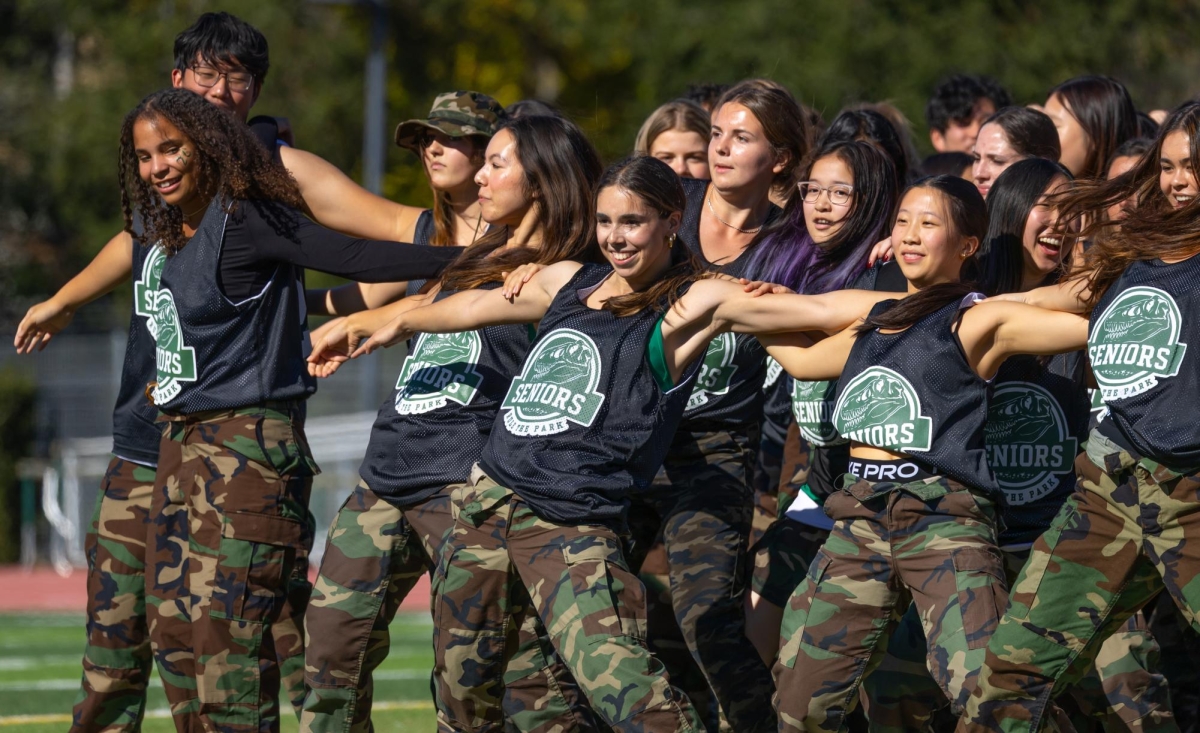
I vividly remember my first day of freshman year. I walked in with my black Patagonia backpack (that many had), with a cluster of friends I had from Greene Middle School. We were refreshed and excited for a new chapter in our lives, a feeling I wouldn’t experience again until now, as a graduating senior. So touching — until seniors stormed a clump of brown benches on some concrete they call “The Senior Deck,” wearing black shirts and camouflage pants. Then, they waved a camouflage flag with black painted letters of “Sko Vikes.” Seniors came to school with their cars signed “Class of –” and friends names were written all over. Bikes rush the parking lot, with the warm weather hitting down like it had all summer long. Whether you’re starting freshman year, experiencing the sophomore slump, going into the dreaded junior year or finishing the last leg, the excitement buzzes around campus.
“Ever since I was a freshman, I would always dream of wearing that jersey and camo,” Paly Juggling Club President Jonathan Bakash
said. “That first day is one I’ll never forget … a legendary moment of my life. You would hear rumors of Spirit Week, look up at the seniors towering over you and meet your scary new English teacher. With that nervousness though, it puts you in new situations, really allowing you to see what Paly was all about.”
Spirit Week
Spirit Week arguably just might be the best week of the year: dress up every day of the week with different themes, a tradition
that stretches back longer than our parents. My favorite day was always salad dressing days, where freshman year we wore sports jerseys for “healthy choice,” sophomore year we dressed up as cowboys for “ranch dressing,” junior year we wore the granola style as “crunchy” and senior year we wore togas as “cesar salad.” Serving as Spirit Commissioner for my senior year, I got to be a part of the behind the scenes. I remember scrambling to tally up the points, starting to announce the rank of winners.
When I announced fourth and third place, I forgot if the juniors or seniors had won. On a whim, I guessed the juniors (I was right, thank goodness). Immediately, their stands erupted, and I was reminded of the same excitement I felt junior year when my class beat the seniors in a game.
“I remember going into day four of spirit week,” Senior Class Vice President Emily Tang said. “There was definitely a narrow gap between the juniors and underclassmen on the spirit point leaderboard … every class was neck and neck in the rapids relay. The relay win was so quick that I didn’t even know we won until I was almost hit with the class flag and the stands behind me erupted into the roars of ‘2-0-2-6 best class to exist.’”
Spirit Week, ever since freshman year, was when I witnessed firsthand the uniform effort of a grade to win, even if it is over something silly. You bond with each other and more importantly, it’s one of the rare times one can feel the Paly community come together all at once.
Academics
Traditions aside, I won’t cover up the fact that Paly was a hard academic environment to thrive in. Sleepless nights were spent coming home at 6 p.m. after a softball game, then trying to understand chemistry problems, read 30 pages worth of history notes or scrambling to finish an entire 52-page magazine at 2 a.m. My peers experienced the same “grind.”
“If you ever get LinkedIn, you’ll see just a plethora of research other people have with these institutions you didn’t get,” Paly Boys Varsity Basketball Captain Kacey Washington said. “It kind of makes you think ‘Am I lagging behind?’”
The goal, for many people at Paly, I felt, is to make it into a “good college,” though the standards for what actually makes one goes undefined. Oftentimes, I felt like I wasn’t doing enough. I felt I couldn’t compete with my classmates because there was always going to be someone “better.” But what I realized is that the words “best,” “better” and “competition” didn’t have to exist. I started to realize that collaboration with peers made everyone stronger as a student and as a person. I could learn so much from my peers just by asking questions or advice. That way, everyone could succeed. In my Advanced Placement Chemistry class, instead of struggling in silence, I formed study groups with classmates, sharing practice resources and tech-
niques to get through the difficult assessments we would collectively face.
“My lab group from AP Physics junior year actually saved me,” Paly Speech and Debate Public Forum Captain Diana Senderzon said. “Anytime I didn’t understand something … they were always willing to help and explain everything to me, or if they were also confused, we would struggle through it together till we made sense of it. We ended up sticking with that group for the majority of the school year and I am forever grateful.”
Journalism
Yes I’m biased, but bear with me. I first joined Verde Magazine as a photographer, with genuine excitement, but uncertainty of what I was walking into. I thought journalism was about telling a story. While that’s true, it’s not that simple. It’s about sitting across from someone, asking them what their life actually looks like and having the discipline to tell that story honestly, with passion, even when it’s complicated. Four years later, my Paly experience taught me how to do that.
We came into this school knowing and carrying a reputation on our backs written by other people in national magazines, local newspapers and word of mouth. And some of it was true. The pressure was real, and so were the sleepless nights. The weight of feeling like you weren’t enough, that was real too. But so was the senior deck on the first day of school, and the togas with gold crowns and glitter. So were the study groups in the library at 9 p.m., where someone finally explained the concept you’d been too embarrassed to ask in class. Finally, that magazine you stayed up until 2 a.m. to print — that was real too (you’re reading it right now, or online at least).
Journalism taught me the most important stories to write are the ones people assume they already know. The ones that needed someone to stand up and tell you what it actually looked like from the inside. So consider this, my final journalism
assignment.