

I jolted awake, disoriented. Why was there classical music playing at 3 a.m.? My heart pounded as Mozart’s “Turkish March” blared through the entire house, repeating over and over, echoing from the living room all the way to the second-floor bedroom where my brothers and I were sleeping. Confused at first, it took me a moment to realize it was my grandmother playing the piano.
That memory may seem unusual, but if I close my eyes and think of my late grandmother, most of my memories aren’t, at first glance. I remember reading books together, sharing meals and holding hands in the park.
However, what’s different from most people’s experiences is that by the time I was eight, I was the one reading books to her to keep her calm, bringing the spoon to her mouth to feed her dinner and making her hold my hand to keep her safe walking in the park. This relationship didn’t feel unusual to me because I grew up with a grandmother who had a form of dementia called Alzheimer’s disease.
Born during World War II, my grandmother lived her entire life in France, where I spent every summer since I was born. However, as the years went on, her condition worsened. The disease didn’t just steal my grandmother’s memory. It also stole her away from me, long before she passed away in July of this year.
After being diagnosed in 2010, doctors tried various treatments and medications. But like the estimated 55 million people living worldwide with dementia, there is no cure for Alzheimer’s disease, its most common form, according to Alzheimer’s Disease International. The disease is a progressive condition, gradually causing damage to the brain, leading to dementia. The effects on an individual differ, however, leading to the loss of memory and organization skills. Eventually, Alzheimer’s blocks all mental and physical abilities.
However, there are changes and interventions people can implement, according to Dr. Sharon Sha, a clinical professor of neurology at Stanford University who specializes in Alzheimer’s research.
“Studies show that it [exercise] reduces the risk of developing Alzheimer’s disease and can slow progression,” Sha said. “Cognitive stimulation, eating healthy, sleeping well and social engagement are all key lifestyle factors as well.”
Sha also explained how gender plays a role in the risk of Alzheimer’s.
“Women are at higher risk and two-thirds of people with Alzheimer’s disease are women,” Sha said. “We don’t know the reason. One genetic risk factor, having the APOE4 allele, increases the risk more in women than men.”
We don’t know whether this is a genetic trait in our family, but my grandmother was not the only one in my family with Alzheimer’s disease; both her sister and her female cousin also developed it.
It’s easy to forget what the statistics mean until those risks have names and faces you recognize or even worse, people you don’t recognize anymore.
Everyone in my family loved a grandmother I never knew. As the youngest of her 11 grandchildren, I don’t have any memories of her without Alzheimer’s disease. By the time she was 60, my parents told me they noticed early signs, with her frequently misplacing or losing items such as her car keys or her backpack. She would have trouble finding the words she wanted to say and constantly forgot where she was going when she left the house, getting lost easily. As her memory loss progressed, she would try to cover up her symptoms.
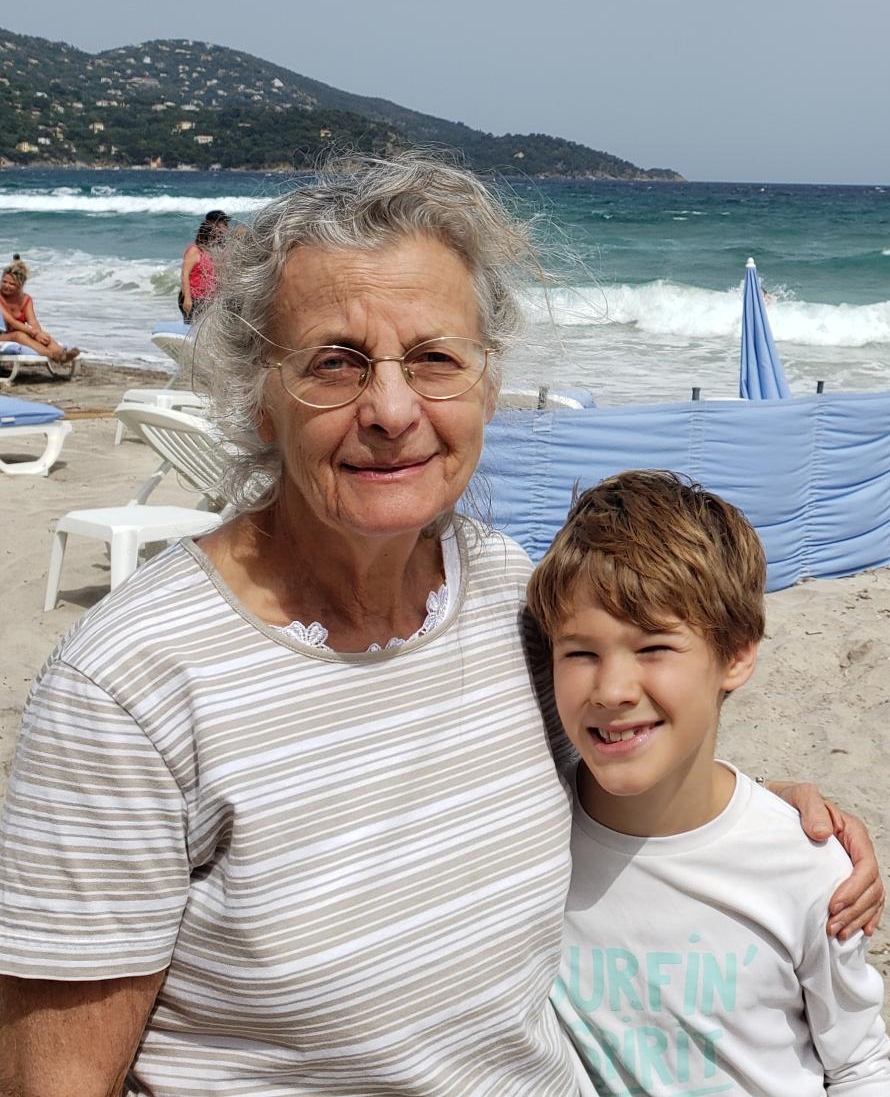
One summer in the south of France, staying in an apartment by the beach, we woke up to find an empty bed and my grandmother was nowhere to be found. Panic set in as we all ran in different directions, dreading she had gone swimming alone or had wandered off. The local police found her walking along the winding road buzzing with traffic and luckily returned her safely.
At this point, she could no longer hide the effects of Alzheimer’s; my family realized she needed constant supervision, so a caregiver moved in with my grandparents. And when my grandfather passed away from COVID-19 in 2021, my aunt moved in. Eventually, three people provided around the clock care for her daily activities as she forgot how to get dressed, cook a meal and even how to brush her teeth. She could no longer read, her speech became jumbled and she rarely made any sense. The rest of the family hardly recognized the woman who had survived a war, been first in her class at her prestigious chemistry college and had a long career teaching high school chemistry all while raising four children. I wish I could have known that person.
As her condition worsened, there were moments when my grandmother turned aggressive.
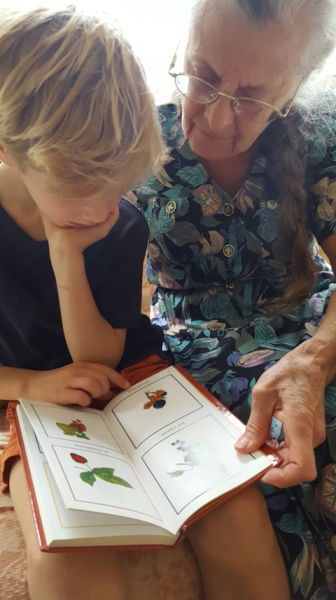
This was hard, as she was a kind, gentle motherly figure who now seemed like a completely different person. She would scream, garble words and slam her hands on the table in frustration. I was too young to understand what was happening, but I could see my father’s face fall as he saw his mother’s hostility. But sometimes, when I held her hand, she would calm down and even smile. In the beginning, she mixed up names, calling my father by my grandfather’s name or forgetting the simplest details.
Near the end, she had stopped recognizing my father — her own son — and me, her grandson, at all. That was the hardest part. Every summer I went to France to see my grandmother, only to be met by someone who saw me as a stranger.
I know my grandmother would want my memories of her to be more joyful, so I choose to think about the things Alzheimer’s couldn’t take.
Half way through my grandmother’s illness, my aunt discovered that keeping my grandmother occupied with manual activities, like knitting, kept her calm. So we took her knitting with us on vacation at the beach, but eventually she would use up all the yarn. Every night, my cousin and I would undo her work so she could start again the next day. One night we took apart all of her knitting but realized none of us, including my grandmother who had forgotten, knew how to cast the yarn onto the knitting needles to start a new piece. My cousin and I went to ask total strangers for help on knitting a scarf at the beach. Looking back, it might have been slightly ridiculous, but despite the sadness, we shared a moment of happiness.
I also have fond memories of piling onto a small inflatable boat with my brothers and cousins while keeping watch over my grandmother swimming beside us, making sure she didn’t drift too far away. At that moment, we felt like a normal family.
One of the last things she could do functionally was play the piano. Mozart’s “Turkish March” that she would play in the middle of the night, was a technically demanding piano piece. It remained engraved in her memory even though Alzheimer’s had so disrupted her life that she no longer recognized the difference between day and night. My grandmother and I both shared a passion for the piano, and sometimes when I’m playing I think about how music was the last language she spoke.
Living halfway across the world from a relative with Alzheimer’s meant taking care of her was complicated. My father would leave us at times to go take care of her for a month or two to give her caregivers a break. While I needed my father at home and missed him, he set an example of what it means to take care of one’s parents.
Despite there being no cure, there was still a way to connect and reach out to her: through touch, through music, through the small moments of recognition that reminded me that she was still there, hiding beneath the illness. Watching a family member slowly deteriorate from Alzheimer’s made me question everything. I became aware of the fragility of health and memory. There have been moments when the fear of developing Alzheimer’s myself overwhelmed me. Everyone misplaces their keys sometimes, but in my house, the first thing we think is: is it Alzheimer’s? But rather than letting that fear become an obsession, I choose to focus on the things I can control. Most importantly, I can value the present by holding on to conversations, people, faces and laughter while I still can.
Alzheimer’s didn’t just take away my grandmother’s memories, it made me confront the purpose of mine.