

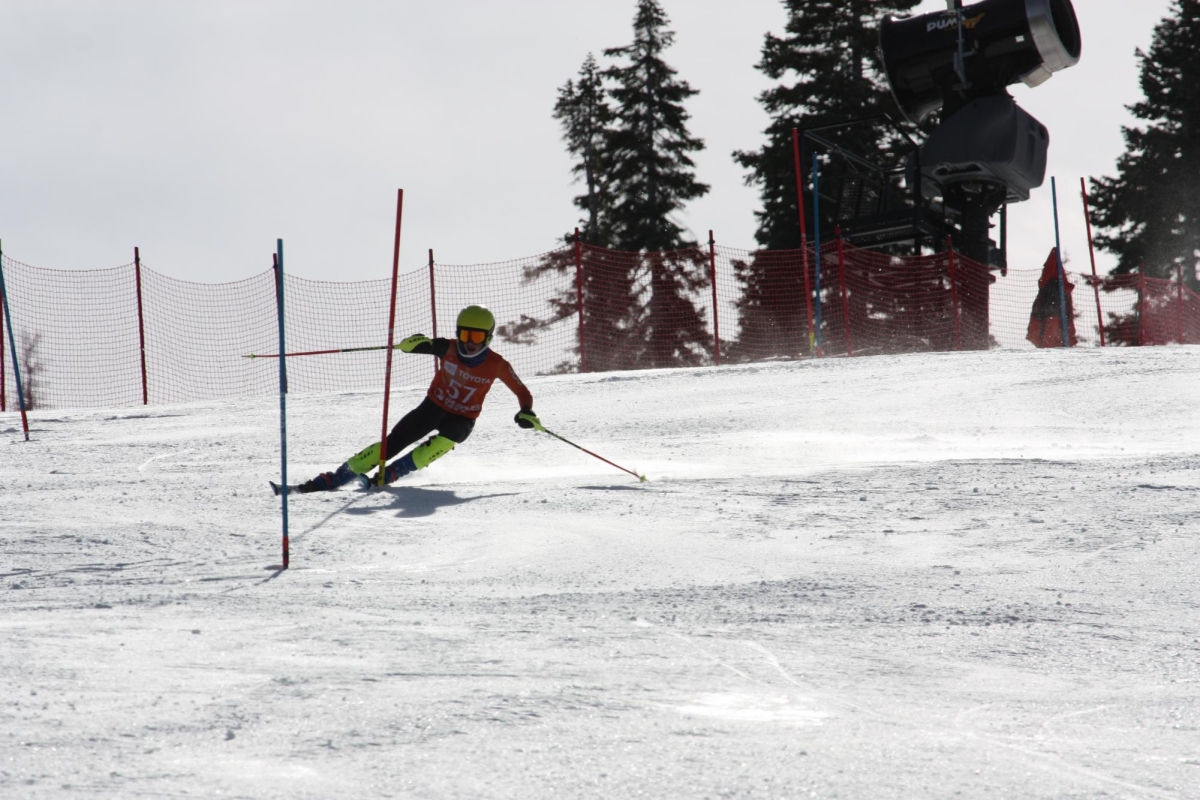
I stand at the start gate, staring at the translucent iced snow peppered with red and blue giant slalom gates. “Ten seconds!” a race official yells. My heart starts pounding. Every training run and race has led to this moment; time slows down, my heart pounds away. Five seconds, four, three, two — I push out as hard as I can, every ounce of my strength driving through my poles into the snow. The only thing that matters now is speed.
Ripping from gate to gate, everything is falling into place, all of my training is going to pay off here and now. Then, click, my right ski releases. Suddenly I’m on my back, no skis, just sliding into the rectangular neon B-netting lining the side of the run.
For me, ski racing is everything. Nearly every weekend, I spend around 24 hours between travel and training — all for the chance of becoming one of 25 Division I recruits in the United States.
Currently I am racing under the Federation Internationale de Ski, which is an international governing body which sanctions some of the highest level competition in ski racing. Races normally take place during the week, Monday through Thursday, meaning missing weeks of school at a time is the norm.
Just two of these races in close proximity leads to months of catch-up work. Being one step behind while everyone keeps marching forward makes it nearly impossible to re-synchronize with the curriculum.
Although there is a large focus on technique in skiing, the main battle is on the mental side. With racing being so precise, the athlete must be solely focused on the task at hand to have any chance of winning or even completing the run.
My teammates and I have all experienced doubts about our abilities after a series of crashes or bad results. This is where having a bulletproof mental side makes or breaks a racer.
Elite FIS racer Sawyer Broman is a junior at South Tahoe High School. Broman says how the only time he even considered quitting was after a sequence of poor results and crashes.
“It [racing] messes with your head for sure, and this year was pretty rough,” said Broman, a junior at South Tahoe High School. “To be honest, I was often doubting if I was capable of reaching my goals. But at the same time if you keep working at it eventually you’re going to get a result.”
The norm to race at this level is to train five hours per day at least four times a week. I can only do about half of that. To make even this work, primarily, I’ve given up social time. With my weekends booked, large amounts of my studying and school work is pushed into the school week, bumping out less important aspects of my life. Some of my other extracurricular activities like soccer and robotics lose hours of practice during the week due to the increased workload outside of school.
This means everything comes after racing. The top racers’ social life, education and especially life outside of skiing is severely constrained because of the strict training schedule and commitment.
Broman said he is now training full time at Palisades Tahoe, with the main goal of racing. To be able to channel his focus, he switched to online classes, while also moving to a school with far less rigor than his previous one.
Broman’s switch to online school caused him to lose touch with former close friends, while also seeking out new ones from around the world.
When Olympic downhill racer Keely Kashman was 15, she switched from in-person high school to an independent study curriculum at Summerville High School.
“I didn’t have the traditional high school experience,” Kashman said. “But I was really happy to be traveling the world and already doing something I truly loved.”
Academies specifically for racing are established throughout the U.S. and the globe, with the sole goal to cultivate the next generation of Olympic athletes.
For me, this isn’t the right path. The idea of gambling on racing, going all in, does not align with my future goals. The problem is if skiing does not work out for these athletes who spend most of their lives training, it can be a challenging transition into other opportunities because their education and experiences outside of the sport may be limited. One injury, one mistake can take everything from an Olympic prospect, leaving them with nothing.
Being a part-time racer has its drawbacks. I have missed countless weeks of school for racing, prompting periods of stressful catch-up work.
While there are negatives to ski racing, nothing can compare to the feeling of standing in the start gate. The surge of adrenaline as you kick out, the despair of a crash, but also the thrill of a triumph with a podium, result or finish.
You cannot simply like this sport you must fall in love with it.