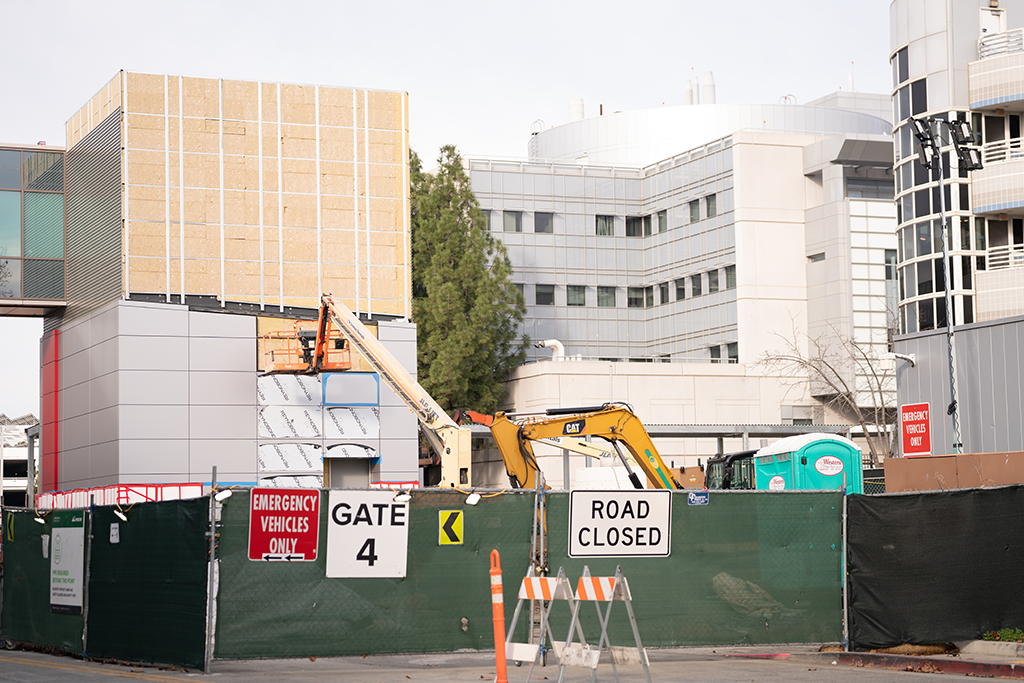
![STANDING UP FOR STUDENTS — After sending a request for proposal to numerous independent companies, Joe Simitian realized he needed to take matters into his own hands. "What I heard informally [from companies] was, ‘we all want to be part of the solution ... but we’re not in a position to create the facility consistent with the request for proposal,’” Simitian said.](https://verdemagazine.com/wp-content/uploads/2026/02/IMG_9042-e1770932947378.jpg)
Joe Simitian was rushing off to his second holiday party of the night, in 2014, when he was stopped by Sigrid Pinsky.
“I’m standing in the kitchen, and she [Pinsky] said, ‘I’m troubled by the fact that if a young person, a teenager in Santa Clara County, needs a secure mental health facility, there’s no place for them to go, and that we have to send kids out of the county,’” Simitian, the former Santa Clara County Supervisor, said. “And I said, ‘Well, that can’t be right.’”
After doing his own research, Simitian was appalled to find out Pinsky was correct.
For adolescents living in Santa Clara County, the only options for acute mental health treatment were in the East Bay or Marin.
“When the [Santa Clara County] Board approved the construction of the new center in 2017, 689 Santa Clara County youths were admitted to out-of-area psychiatric hospitals, staying an average of six days in facilities often far away from home,” Simitian said.
In spring 2026, Santa Clara County will open its first acute mental health facility designed for adolescents. Planning for the Behavioral Health Center has been in motion for 10 years and is pending permits before opening to the public.
The $500 million building, located in the Santa Clara Medical Center, will have 77 beds available to adolescents. The county received $80 million in state grants from California and dipped into the local general improvement funds to finance the rest of the project.
While the mission was to provide beds for adolescents, with more money, beds are also available to children and adults as well. Senior Project Manager Craig Blackhurst, who works at HGA, a national architecture and engineering firm, explains how the architects took extra precautions in treating patients of different ages.
“When they transport patients … they will escort patients through secure spaces, but adults and children will never be in the same space at the same time,” Blackhurst said.
The Behavioral Health Center is one of the few centers in the U.S. that prioritizes choice in a place where choice is normally taken away. The center has safely implemented features such as the patient’s ability to choose if their lights are on, how much sunlight enters and access to fresh air in their rooms. Terri Zborowsky, a senior design researcher at HGA, helped implement evidence-based solutions into the final design. Her research reveals the hidden truth of most behavioral health centers.
“99.5% [of patients] do not have access to fresh air in individual rooms,” Zborowsky said. “It’s the thoughtfulness that goes into how we create these really wonderful spaces that still make people feel a part of the world and give them some choice.”
Finding someone to facilitate the building was the first hurdle Simitian encountered. In 2016, the county drafted a request for proposal (RFP) where they would pay independent companies to open a Behavioral Health Center in Santa Clara County. Unfortunately, the RFP was declined by all potential bidders.
“What I heard informally [from companies] was, ‘we all want to be part of the solution. We’d all like to have the benefit of having a facility like this in the county, but we’re not in a position to create the facility consistent with the request for proposal,’” Simitian said.
Simitian realized that Santa Clara County would have to take on the burden of running the facility. After urging the Board of Supervisors to approve development of the center, Simitian convinced them in 2018 to construct a county-run inpatient psychiatric service for children and adolescents.
Even though the center marks a significant improvement in mental health resources available, Simitian highlights the need for a continuum of care, where help is available for every step of recovery once adolescents leave the Behavioral Health Center.
Allcove, a youth mental health resource located in Palo Alto and San Jose, is one example. Allcove has helped support students with vastly different needs: their programs range from fun teen-bonding activities to meetings with trained medical professionals.
Gail Price previously served on the Palo Alto Board of Education and City Council and shares similar views to Joe Simitian: during her terms, she advocated relentlessly for more mental health support.
“I think it’s extremely important for families, community members, nonprofits, providers of services, city and county elected officials and members of the public to continue to advocate for the need for additional services,” Price said.
With the opening of the Behavioral Health Center, Santa Clara County will be able to cover adolescent needs from the least extreme measures to the most, and it all materialized from a single conversation between Simitian and Pinsky.
“There’s skepticism … that people have about whether or not one person can make a difference,” Simitian said. “But somebody walked up to me at a party and a little more than 10 years later, these [psychiatric] beds will be there for generations of students to come.”
Additional reporting by Rohan Kini