

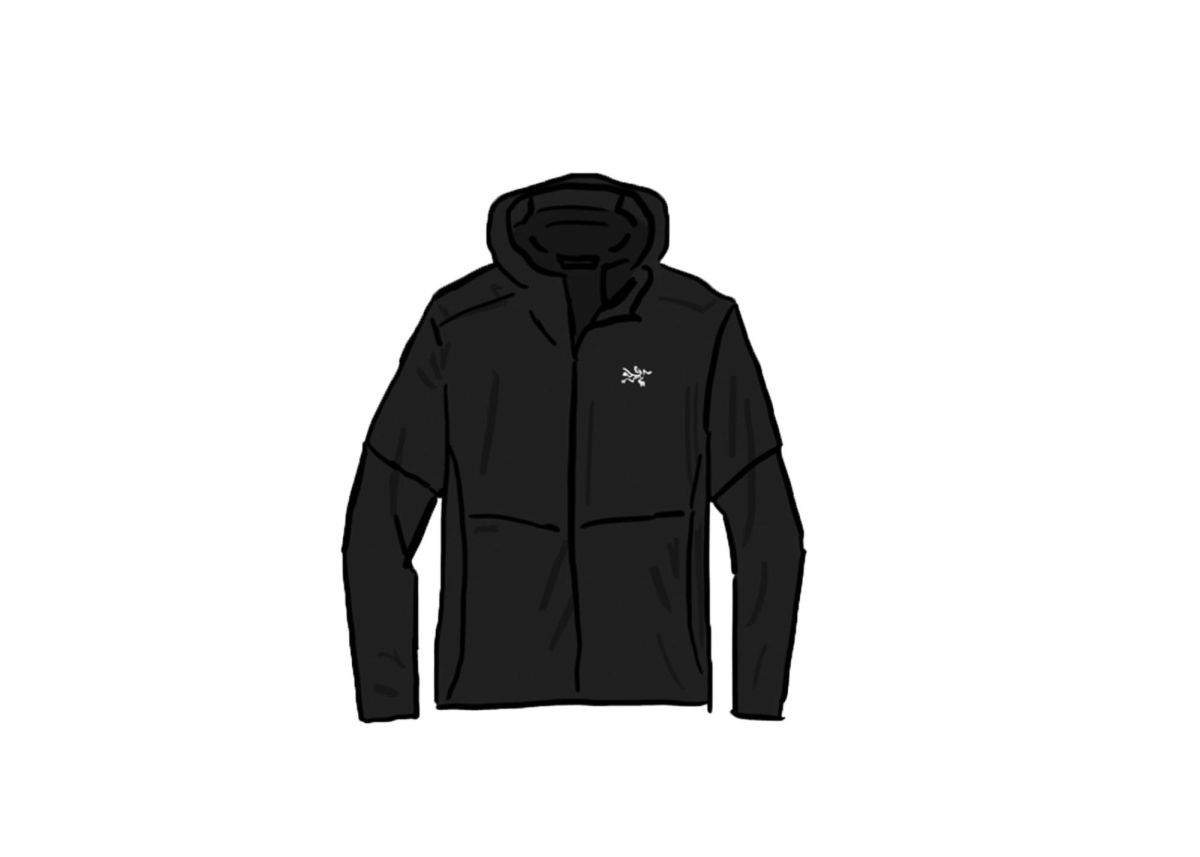
Picking up a pair of black and silver Gore-Tex Salomon XT-6s ($200) and zipping up a dark grey Arc’teryx parka ($400), students set off another normal day in school, where they will spend most of their time sitting indoors in a classroom.
Introduced in 2017 and taking off as the pandemic ended, Gorpcore has emerged as a fashion trend where people dress in high quality sports gear designed for the extreme outdoors as streetwear.
Originating from Jason Chen, a writer for “The Cut” who used the phrase “Good Ol’ Raisins and Peanuts” to describe the outdoor clothing’s aesthetics, the phrase gorpcore developed from the word “core” being defined as a synonym for genre.
Leading brands of the trend include Arc’teryx, an extreme weather fashion retailer, and Salomon, an outdoor footwear brand.
The outdoor weather fashion trend can often mean a hefty price tag. Prices range all the way from a few hundred dollars for a pair of hiking shoes to around a thousand dollars for a parka.
Palo Alto High School junior Annie Kasanin has grown up with her family exploring the outdoors and therefore buying gear and products from different outdoor brands.
“I’ve collected most of my higher-end outdoor gear over time from hiking and backpacking,” Kasanin said, “I own clothes from Patagonia, Arc’teryx, The North Face, Fjallraven, and Helly Hansen, as well as a few other smaller high-end brands like Mont-Bell, Sportiva and Salomon.”
Many of the brands that Kasanin owns are considered “mainstream,” however, Kasanin believes that if they were not constantly advertised and shown on social media these brands wouldn’t be as accessible.
While most outdoor brands are found on Instagram and TikTok through content creators, Kasanin has seen many advertisements and photo inspirations on Pinterest.
“One company I found out about a year ago is Gramicci, which is a climbing brand […] and I immediately came to love their cool logo and designs,” Kasanin said. “If the ad didn’t reach me, I’m not sure I would have heard of it.”
Sophomore Wyatt Edson, a member of the cross country team, runs in outdoor conditions.
Edson said wearing North Face gear is not a part of the Gorpcore trend for him, but a necessity for outside conditions.
“I find it very comfortable, and I get a discount on it at work,” Edson said.
Edson, who works at Fleet Feet, a footwear retailer, said he recalled many people purchasing more outerwear gear, especially the models that were winterized, or made for rugged environments.
“Over the past few months, I’ve seen a bigger increase in people buying speed goats [trail shoes],” Edson said. “I’ve also noticed people are buying Solomons, which, for the shoes we have, are all trail shoes.”
However, Kasanin thinks these types of shoes and clothing are convenient for Paly students to wear on a daily basis.
“A majority of kids bike to school and have sports after school, so it makes sense that they want to be comfortable and ready to walk or bike around,” Kasanin said.
However, Kasanin highlights that there are some extremes to wearing gorpcore clothing and gear to school.
“I don’t think any Paly student needs to wear an Arc’teryx shell and Patagonia hiking pants every day to school,” Kasanin said. “I think it’s more about a balance between casual wear like jeans and more outdoorsy clothes like fleeces or canvas jackets.”
With media gaining the attention of consumers, retailers have stocked up on Gorpcore items such as windbreakers and shells and beanies. These items still hold controversy with their use.
Reed Hoffman, a sophomore, said Gorpcore was yet another trend that will die down as we go into 2026. Hoffman sees this trend as a prime example of overconsumption and overkill.
“You have one trend; but then the next trend tends to come in and do the opposite of whatever that other one was,” Hoffman said. “[You] want to look unique, and you want to be different.”
Arc’teryx employee Shirley Chi said that most students who come into the Arc’teryx store in Stanford Shopping Center purchased the accessories rather than most flagship waterproof jackets.
With Arc’teryx being a brand aimed for professionals, Chi stated students come more to browse.
Over the span of around a year Chi worked at Arc’teryx, she said the company increased the prices of items incrementally – the Arc’teryx Toque (beanie) increasing from $50 to $60 over the time she worked at the outdoor fashion brand.
“Within the market and whatever adjustment they have to profit off of it, I understand that there always can be bumps,” Chi said. “But for the beanie itself to rise a whole $10 while I’ve been here is the crazy part.”
Senior Estelle Dufour spends a lot of time on her long breaks from school outdoors hiking and backpacking in many national parks like Glacier and the Canadian Rockies.
She believes that buying affordable products can be just as good, if not better than buying from expensive brands.
“I think if people are spending a lot of money on something that is designed to be best outdoors in specific conditions, it’s kind of just a waste of their money,” Dufour said. “Might as well buy a regular item that will most likely be less expensive.”
A concern raised by many Paly students is cost. Promoted by influencers and fashion hobbyists on social media, most of them adults, Gorpcore encourages wearing clothing that is out of budget for students.
According to the National Retail Federation, most students in K-12 grades spend around $300 on clothing a school year; a puffercoat jacket from the NorthFace costs $380.
Edson said there will always be students who are willing to spend more on clothes.
“I know some people, they really enjoy collecting clothes, and they’re fine spending a ton of money on that because it’s their hobby,” Edson said. “And I think that’s completely fine.”
Two of the alternative brands people turn to are Columbia and Patagonia.
These brands have extensive items under $100 and a popular refurbished program, where used or returned gear is resold for a discount.
Another way to get outdoor fashion items for less is buying used items in thrift shops and online marketplaces.
Hoffman said there are more upsides to thrifting than shopping.
“I focus on quality over quantity,” Hoffman said. “I’d be more willing to spend $600 on a pair of jeans that’s gonna last me multiple decades than buy my $8 pair of jeans that I have to replace every six months.”
However, there are plenty of alternatives to save money through secondhand stores and refurbishing programs.
These methods allow students to be both more sustainable with their purchases and wears and also opt for a cheaper alternative.
Hoffman said fashion trends always shift to counteract the current trends as time passes.
“I think the sheer modern look of gorpcore, people [will] see that enough,” Hoffman said. “They’re like, ‘oh, I want to be different. I want to be cool.’ So they then try to do the opposite of that.”