

From student journalists feeling pressured to depoliticize or refrain from publishing their op-eds, to student immigrants hesitating to speak out for fear of deportation, recent government rhetoric and actions have led U.S. residents of all ages and backgrounds to think twice before expressing their right to free speech. In our own newsroom, discussions of source and writer anonymity have taken place due to the potential for political retaliation.
This trend, dubbed the “chilling effect,” is the self-censorship of free speech due to fear of legal or social consequences. In our feature story “The chilling effect,” writers Leilani Chen, Chris Jeon, Shaurya Thummalapalli and Julie Yang interviewed a wide range of student journalists who have been subjected to this phenomenon.
This sad reality extends beyond the newsroom. In the verbatim story “Vote at 16?” Managing Editor Lara Saslow delves into another form of youth expression which some feel is suppressed: voting. Vote16USA Palo Alto, one chapter of an organization founded by local teens, aims to lower California’s voting age for civic elections to 16.
The stakes of this debate are underscored in the feature story “Prop 50” by Jaron Leung and Julie Yang, which unpacks California’s proposition to add five safe Democratic seats to the House of Representatives in order to counter mid-decade partisan redistricting efforts by Republican-led states.
On a local level, within the Palo Alto Unified School District, some students feel that they are being underrepresented in their own education. In the feature story “Who are we becoming?,” Ananya Adya and Leela Kulkarni explore PAUSD’s evolving values and the lack of student voices in district decision-making.
With such consequential — and oftentimes polarizing — decisions being made across the country on both a political and educational scale, it’s more important than ever that we’re able to freely express our diverse values and beliefs.
As detailed in “The chilling effect,” the Stanford Daily is among the first student-led journalism publications to legally push back against the Trump Administration’s immigration enforcement strategy, which has frightened many international students at Stanford University into silence.
With all the quiet censorship occurring around us, it’s easy to feel isolated without explicit solidarity. We hope that this issue informs you of the actions the community is taking to encourage people to speak up. If there is one thing we hope you take away from this edition, it is that your voice still matters.
On the cover
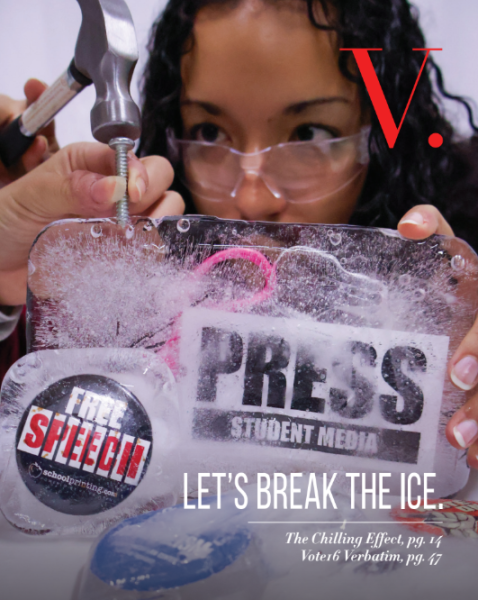
Palo Alto High School senior Amalia Tormala attempts to chip a press pass out of an ice block alongside various “frozen” student press freedom related pins in a photo taken by Editor-in-Chief Kensie Pao. Breaking the ice represents efforts to combat the “chilling effect.”