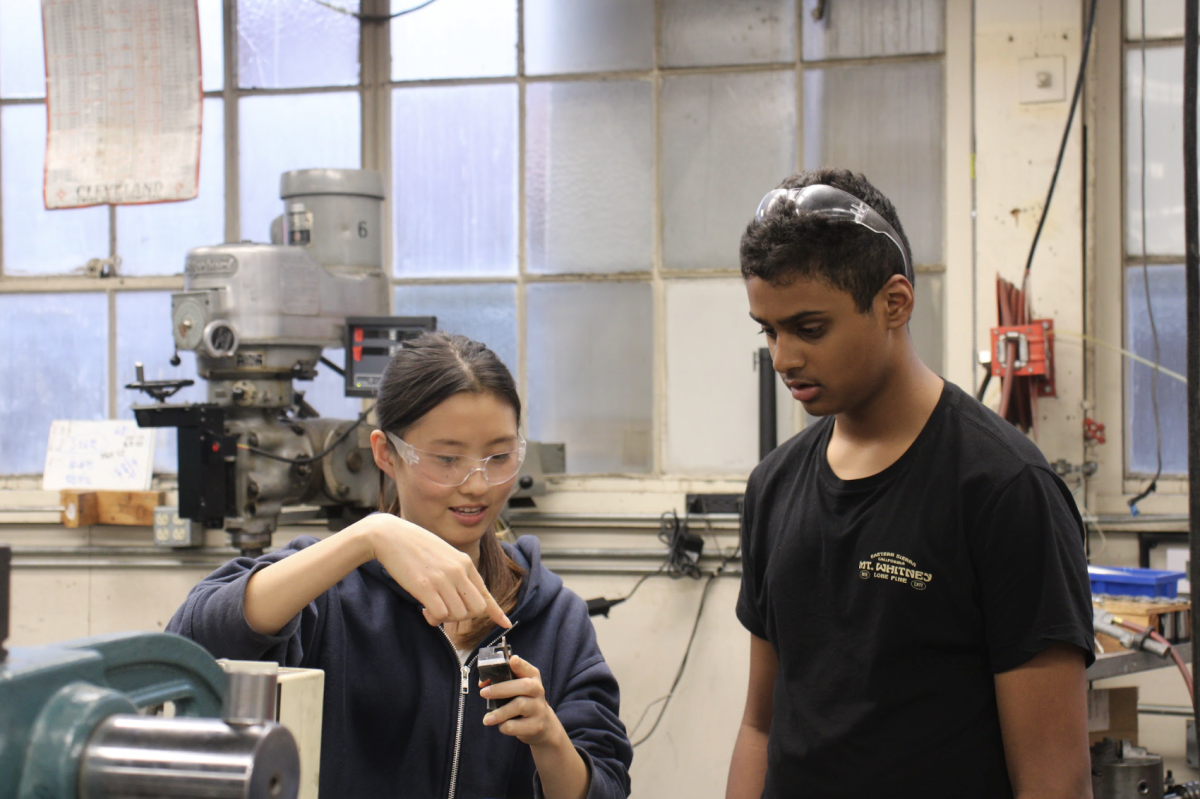
![DEEP DISCUSSION — Co-captains, Jeong and Brooke Chandler lead a team meeting. “Just do it [robotics], you’re going to find your people,” technical director Hana Kapdia said.](https://verdemagazine.com/wp-content/uploads/2025/11/Screenshot-2025-12-01-at-11.28.28-AM-1200x785.png)
A LARGE ROBOT STANDS in the center of the lab, surrounded by a group of kids discussing ideas. In the middle of the crowd, surrounded by mostly boys, are three girls who lead the entire Palo Alto High School Robotics team: seniors Yuna Jeong, Brooke Chandler and Hana Kapadia.
Previously, Paly Robotics was led by and consisted mostly of males because not many girl were exposed to the opportunity. This year, however, robotics is led by three girls.
Through challenges of being the minority in the lab and competitions, Jeong, Chandler and Kapadia are eager to recruit and encourage more girls to join the program.
Since 1996, the Paly Robotics team has been led by males. In 2012, only one out of 27 Paly Robotics’ team members was female, according to the Paly Robotics Diversity Plan.
Currently, Jeong and Chandler are the team’s co-captains, while Kapadia is the technical director. With boys and girls together, the leader and team are challenged to include everyone’s ideas regardless of grade, gender and skill. As a mostly male-dominated field in professional careers, STEM hasn’t always been something that pulled women into joining, especially robotics teams.
There has never been an all girls leadership team in Paly Robotics history. So, the three girls are taking their role seriously to set an example for girls in younger generations.
Jeong joined the school’s robotics team her freshman year after her older sister had shared her robotics experiences as one of the only girls on the team, encouraging Jeong to join and represent girls. According to Jeong, when girls come to join Paly Robotics, members and leaders of the team work together to make them feel supported and excited to stay involved.
This change from a stereotypical environment of a male-dominated space, allows the team to have different gender perspectives.
“If they [girls] come, we show up with an eager mindset, we’re willing to teach anyone how to do anything, which I think has been really great,” Jeong said.
Kapadia has been working with Jeong on the team since her freshman year and has witnessed the team’s motivation to growing diversity.
“Our team has always been very diverse, and it’s always been 50/50 between boys and girls so I’ve never felt isolated or alone,” Kapadia said.
In addition to the lengths of recruitment that Paly has done to create a diverse group of people for the team, other Bay Area teams share the motivation to grow gender diversity.
One of Paly’s computer science teacher, Roxanne Lanzot started an all-girls robotics team while working at Notre Dame High School, an all-girls Catholic school. At first, it was difficult to get her idea across administration for a robotics team because of the stigma against girls in STEM, but support from other teachers at the school encouraged her to continue to follow through with her vision.
The recruiting process for the new team proved difficult, as it was unconventional for girls to be working and learning in the STEM field. Building the team gave exposure to more girls who were shying away from subjects in STEM, and giving them freedom to explore their interests.
To solve this challenge, Lanzot and some established members made the recruitment process fun. They designed merchandise people would be proud to wear, and gave themselves a nickname of the “Janksters.” She noticed that when this process was more fun there was a greater outcome of girls joining the team.
Through Lanzot’s commitment to creating an all-girls team, Notre Dame has built their own facility dedicated to STEM, giving opportunities for students of all grades and genders the ability to hone their passion for math, science and technology.
“They [the robotics team] have a wonderful team of mentors, and are still competing today,” Lanzot said, “And they’re much bigger and better than they were when I started the team.”
Just as Lanzot worked to introduce robotics to her students, Paly junior and Peninsula Robotics Media Lead, Mehr Thawani works to do the same.
The lack of female participation in robotics teams is often attributed to their minimal exposure to the STEM field and robotics due to the stereotypes against women participating in those types of subjects, according to Thawani.
“I have noticed kids from Paly often lose hope or don’t want to participate in robotics anymore after being rejected from Paly Robotics,” Thawani said, “They are often unaware of the other options available like Peninsula Robotics.”
With attempting to recruit more girls for the robotics team, Thawani remembers and understands her hesitation to join the team due to the lacking of ratio of girls to boys, but regardless, she takes her job of recruitment seriously so that Peninsula robotics can become a diverse and inclusive team challenging the stigma of single-gender representation.
“I remember feeling really out of place during my first few months on the team,” Thawani said, “There were not many girls I could turn to, so it was difficult to participate and engage with the team.”
Kapadia agrees.
“There have been moments when I walked into a robotics event, looking around and realizing I was the only girl out of 12 teams there,” Kapadia said.
For Clara Manolache, Paly junior and Peninsula Robotics software developer, the key to closing the gender gap in STEM is making girls feel like they belong in those spaces and showing them that stereotypes can be broken.
“I feel like a lot of guys just don’t know how to work with girls,” Manolache said. “Right now, in high school, it’s good for both of us to see ‘oh, we can work together.’ We’re like a team. No matter what gender you are.”
Now with social media being the most efficient and effective way
s of influence, Thawani uses platforms to reach the target audience of girls to join the team.
“Each year, our ‘media lead’ position member, promotes recruitment on our social media platforms so people are well informed about it,” Thawani said.
However, recruitment doesn’t only come from social media, Thawani also talks to her peers about joining the team.
Even with societal bias and the challenge of recruiting more women to robotics worldwide, Kapadia hopes to see more women in leading roles in the future of robotics.
“Just do it,” Kapadia said. “You’re going to find your people, you’re going to find your friends.”