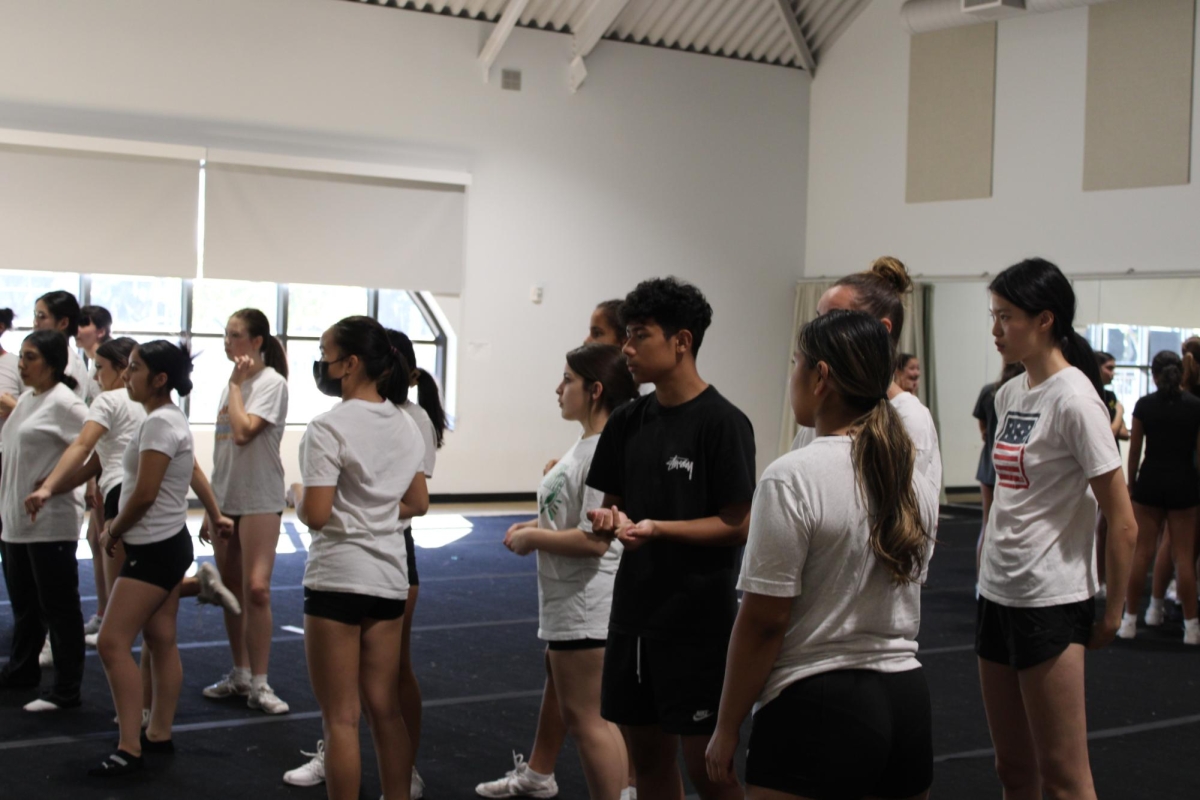
The dance studio comes alive as upbeat music blasts from the speakers, where dozens of cheerleaders practice stunts for an upcoming football game. Among the cluster of cheerleaders in the room, there’s just one boy. As the only male cheerleader on the team, Palo Alto High School sophomore Carmine Unga is challenging long-held stereotypes with his passion, athleticism and joy every time he steps onto the field.
According to a survey conducted during the 2021–2022 school year by the National Federation of State High School Associations, out of the 144,209 competitive high school cheerleaders in the United States, only 3,657 were male, representing barely 2.5% of the sport.
Today, the sport is often associated with girls in striped skirts and pompoms. However, organized cheerleading actually emerged as a male-only collegiate sport in the late 1800s, according to USA Cheer. But female participation proliferated during World War II when college-aged men went off to war, ultimately leading to the feminization of cheerleading we see today.
Despite a disproportionately female high school cheer scene, college cheerleading is completely different. According to the University of California, Los Angeles, 50% of college cheerleaders are male.
“I’ve done my research on cheer before, and I’ve seen there’s a lot of co-ed stuff,” Unga said. “If they can do it, so can I.”
When Unga first joined Paly’s varsity cheerleading team in his freshman year, he didn’t have prior experience with cheer and had just joined the team for fun. But over time, Unga realized that cheer was more than just a sport: it gave him a sense of community.
“I love it [cheer] because it’s a great way to really stay close with all of your teammates,” Unga said. “It’s really fun to make connections with people you thought you wouldn’t ever have to talk to.”
Paly varsity cheerleading coach Helene Gurewitz said Unga’s impact extends beyond his skill.
“His energy is so infectious,” Gurewitz said. “I don’t think that anyone who has come across Carmine will leave without a smile.”
Paly senior and stunt captain Katherine Zaner, who has worked with Unga since his freshman year, said that he has had a positive influence on the team.
“The energy that he brings is unmatched,” Zaner said. “He’s genuinely such an amazing person.”
Gurewitz said Unga’s role on the team signals a shift in cheer culture, transforming the precedent of who can participate in female-dominated activities.
“Representation is really important,” Gurewitz said. “I think [from] him just being out there, other students at Paly can look and be like, ‘oh, I didn’t even realize that was an option.’”
Gurewitz hopes to expand the team’s reach to more demographics by hosting open practices, where team members can invite a friend along to introduce them to cheer.
“Hopefully, people will bring their friends of any gender and be able to open up the sport in that way,” Gurewitz said. “It can also be helpful to try and destigmatize and unlearn that institutional sexism and institutional homophobia that surround us in society.”
Despite her hopes for breaking stereotypes, Gurewitz also acknowledged the challenges in doing so.
“They’re going to say awful things, but at the end of the day, the team loves Carmine,” Gurewitz said. “And if you see him, say ‘hi.’ He’ll probably say ‘hi’ back with a big old smile on his face.”
Unga encourages people to consider stepping into roles that go against the norms, and to take a leap of faith.
“Try getting out of your comfort zone and try something new for once,” Unga said. “Don’t be afraid to do whatever you want.”