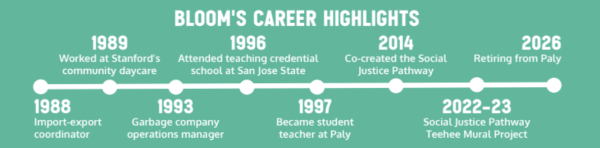
After nearly 28 years of teaching, Palo Alto High School Economics and Advanced Placement Macroeconomics teacher Eric Bloom is retiring. Bloom’s teaching career was not linear. He embarked on various job endeavors at an import-export firm, a Stanford daycare and as an operations manager at a garbage company. As a teacher at Paly, he embodied a teaching philosophy based on the lessons learned from each of these professions and his own experiences as a student.
“As a high school student, I knew the teachers that I liked because they made me feel like I was smart, that I could do things,” Bloom said. “I’m, in a sense, trying to be the teacher that I would have liked and respected. It both makes you feel important and humble at the same time … So, that’s a gem that I’ve carried forward.”
When Bloom arrived at Paly as a teacher, he felt that the traditional classroom model wasn’t the only way to teach students. Years later, building on this belief, he, along with Paly English teacher Erin Angell, created the Social Justice Pathway. This idea was initially conceived after Bloom visited a school on the East Coast that practiced project-based learning. The visit inspired him to create a new curriculum and program focused on breaking the traditional transactional relationship between student and teacher.
“The idea of making it project-based was to break this relationship of ‘you do the work, I give you the points,’” Bloom said. “We both wanted to see if we could get away from this relationship of it being so grade driven.”
That philosophy flourished under Bloom’s guidance, and evidence of its success is now displayed on the wall of the Paly math and history building for all to admire. During his final year of teaching SJP, Bloom brought to life an idea that came to him when he visited the San Francisco Museum of Modern Art, where he had seen a 70-foot-wide and 22-foot-high mural of Diego Rivera. He wondered: could his students do something similar?
Bloom designed this project, asking students to choose a topic from U.S. history, specifically from the westward expansion, and create a large mural paired with a content guide and an artist’s statement.
He said nothing in the mural would be accidental.
“Everything is there for a reason,” Bloom said.
Sixteen students from two of his classes accepted the challenge. They spent the whole spring semester and summer researching how to best represent their subjects, among them including a Cherokee Nation historian.
The completed mural caught the attention of outside parties, including the district superintendent, the Cherokee Nation and local news outlets.
“It was a big, huge event,” Bloom said. “It was really that proud moment that your students were able to do this great work.”
What made him proudest was that his students decided to do this without the motivation of a grade.
“They didn’t get any credit for it,” Bloom said. “They did it because they learned these skills and they wanted to put out something interesting and engaging.”
Bloom’s path to Paly was anything but linear and he’ll be the first to tell you that his various jobs shaped who he is now.
He grew up in Palo Alto and graduated from Gunn High School, then attended Foothill College before going to University of California Davis. After college, he took a job as an import-export coordinator, tracking invoices and managing shipments of silk. After, he enrolled in credential school, followed by a short stint at a Stanford daycare. Then he pursued perhaps, his most memorable job, his role as an operations manager at a garbage company.
He said the garbage job shaped him most as an economics teacher.
According to Bloom, the garbage company had a chronic attendance problem, with workers frequently absent after a night out and shifts going vacant. The management solution was to offer incentives: workers with perfect attendance were rewarded and if they finished their route early, they could go home early while still receiving a full day’s wage.
“What I really learned, especially as an econ teacher, from being a garbage man, was this whole idea about incentives and putting things in place to allow people to make choices that are going to benefit them,” Bloom said. “The garbage company had this huge problem with attendance, just like schools.”
His position at a daycare shaped him as well. Working with children taught him something counterintuitive about the relationship between high school seniors and preschoolers.
“Ironically, preschoolers and seniors are very similar in the sense that they’re getting ready to transition into this new, serious world,” Bloom said. “With the seniors, you need to be able to self-regulate and how to manage your own time and to make choices about what you’re going to study, how you use your class time. So I try to set up the classroom so there’s these opportunities.”